Ads

Thursday, April 16, 2015

A Look at the Upcoming Wii U Retail Games


The next game for the Wii U is Splatoon, and it's scheduled to come out on May 29, 2015. It's a third person shooter with a unique twist. Instead of shooting bullets or lasers, players will be shooting paint and attempting to cover territory with it.

The characters are called Inklings and can change from humans into squid form. As opposed to most shooters that are all gritty and "mature" this will be family friendly game for all ages.


A decision that seemed to go along with being for all ages was to not include voice chat as is common for many games of the genre. The developers have cited the negative attitudes shown on the voice chat in online gaming. Critics of this decision have stated that they could simply allow people to be muted as in most online games. Personally, I don't feel like it is a necessary feature and the game will probably be fine without it.

The game's focus will be on online multiplayer, but there will be a single player campaign as well. There will also be local multiplayer for at least two people.


After Splatoon, it seems the next Wii U game with a solid release date is Mario Maker. This game obviously features the iconic character but is a unique concept in not only the franchise, but in Nintendo games in general. The game involves the player making their own 2D Mario levels than can be shared online.


The game features four different art styles from different games throughout Mario's history. Of course, one of them is the NES classic Super Mario Bros. It was released in September of 1985 and Mario Maker will come out this September to commemorate the 30th anniversary of that game.


Other art styles to be included are those from Super Mario Bros. 3, the NES game released in 1990 in the United States, and Super Mario World, the first Mario game for the Super Nintendo.

The final art style is that of the New Super Mario Bros. series, which has appeared on systems such as Wii, Wii U, DS, and 3DS.


Tuesday, April 14, 2015

Even more of my fanmade music videos!


My first video today is set to music by Caribou, the alias of Canadian electronic artist Dan Snaith. He also released music under the monikers Manitoba and Daphni.

The track I chose is called "Can't Do Without You"  the first song from the 2014 album Our Love. The clips I picked are all from silent movies.


Next, we have another video using silent films. This one is set to "Extwistle Hall" by Demdike Stare. Enjoy!


Please follow me on Facebook or Twitter. 

Monday, April 13, 2015

A Comparison of the Top Grossing Films Throughout History (Part III: Women in Film)


In part one of this series, I looked at the top grossing films from various years throughout history. My focus was on genre and the seeming resurgence of fantasy and science fiction flicks.

Part two was about sequels and remakes and whether or not they have truly taken over theaters.

In this portion, I have decided to look at the top grossing films by year and see how many of them had women as directors or writers.


I checked out all even years from 1930 to 2000 and all years from 2002 to 2014. In decades like the 30s and 40s, I used the biggest moneymakers in the US only as opposed to worldwide. This is due to the data being more complete and accessible for the American box office in these years.

It may not come as a shock that when I looked up all the top ten grossing movies from the even years in the 1930s, not a single one of them was directed by a woman. After all, this was the thirties; women had made some advances but they still had a long way to go in terms of gender equality. It's hard enough for women to break into the film industry in certain positions now, imagine how bad it must have been in the 1930s!

Directing is still a male dominated field, but what about writers? You might find it surprising that a decent amount of the top films in these years were written, at least partially, by women.


In 1930, the sixth highest grossing film was The Rogue Song, a romantic musical directed by Lionel Barrymore. The script was penned by John Colton and Frances Marion. Marion is easily one of the most significant female screenwriters, especially in her time period.


That same year, she also wrote The Big House, which garnered her an Academy Award win for best adapted screenplay. This made her the first woman writer to win an Oscar.

She won another Oscar in 1932 in the Best Story category for The Champ, thus making her the first writer of any gender to win two Academy Awards. The Champ was the fifth highest grossing film of 1932. She even got nominated again in 1934.


Monday, April 6, 2015

Another pair of my fanmade music videos (Model 500 and Com Truise)

I just finished a couple more of my unofficial music videos.

The first is set to the classic electronic track "No UFOs" by Model 500, aka Juan Atkins. The video is a compilation I created of ridiculous dancing.


The second is for the track titled "VHS Sex" by Com Truise from his 2011 album Galactic Melt.


Thursday, April 2, 2015

Andrei Tarkovsky's first film Ivan's Childhood (1962)


The Russian director Andrei Tarkovsky is an undisputed legend in art house cinema, mainly for his renowned works Andrei Rublev, Stalker, and Solaris.


I finally saw his first full length film recently, Ivan's Childhood. It was released in 1962; previously Tarkovsky had only made student films no longer than 45 minutes. Ivan's Childhood is much different than his later works in many ways.

Absent are the shots that go on for minutes unbroken. Not to say the editing is fast, it is still slower than most Hollywood films, even of the era.


According to the Unspoken Cinema the average shot length of Stalker is a minute and eight seconds. The ASL in Andrei Rublev is 34.1 seconds and in The Mirror it's 23.2 seconds. By comparison, in Ivan's Childhood the ASL is 17.9 seconds. Not exactly MTV-style editing, but you get the point.


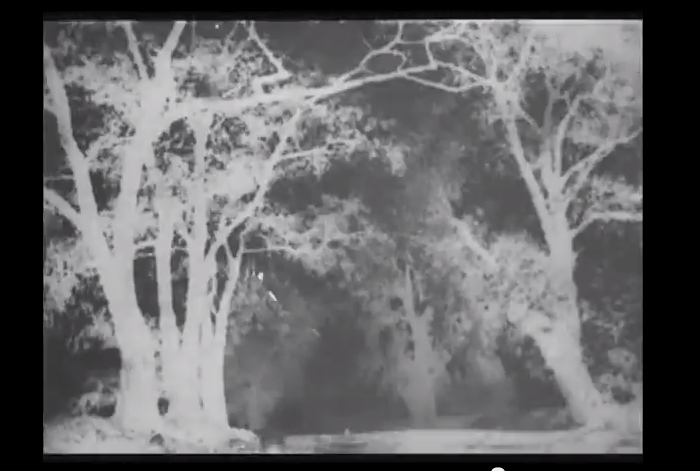
There is also a bit more experimentation with form than his later films in some ways. There is even some use of what appears to be handheld camera work. Tarkovsky also experiments with negative imagery in what results in a very striking effect.


Ivan's Childhood is shot in black and white. All of his later films would be in color, but he would often include B&W segments as in Stalker and Andrei Rublev.


Furthermore, at 95 minutes it is his shortest feature (this is disregarding his student shorts and the 63 minute documentary Voyage in Time). Three of his other features have a running time of over 2 hours and 40 minutes and his final film The Sacrifice is also quite lengthy at 149 minutes.

Overall, the film is much more accessible than most of his other work.


The director of photography was Vadim Yusov, who had worked with Tarkovsky on one of his student films and would later collaborate with him on Andrei Rublev and Solaris.  He also later worked with another significant Russian director, Sergei Bondarchuk.

The film won the highest prize, The Golden Lion, at the 1962 Venice Film Festival. It was selected as the Soviet Union's entry for the Best Foreign Language Film at the Oscars, but didn't get a nomination. Still, the critical acclaim put him on the map in the world of international art house cinema.


The film's acclaim also marked a bit of a resurgence for Soviet cinema. Russian films were very influential in the 1920s due to great filmmakers like Sergei Eisenstein and Dziga Vertov. However, films soon fell under strict state control and Russian films weren't that significant on the international stage in the 1930s and 1940s.

The "Khrushchev Thaw" of the 1950s led to less censorship led to directors like Mikhail Kalatozov and Grigori Chukhrai making critically acclaimed films. This came to a head with Ivan's Childhood in 1962. Tarkovsky is now easily considered one of the two most significant Russian directors, along with Eisenstein.


Ivan's Childhood was based on a short story called "Ivan" by Russian writer Vladimir Bogomolov. Tarkovsky did not choose the story; he actually said it wasn't that good, according to IMDB trivia. However, this was actually a plus in his mind as he found weaker stories easier to adapt to film.


While the film does differ from most of the Tarkovsky oeuvre, I highly recommend it as essential viewing for anyone interested in art house cinema.


Please follow me on Facebook here or subscribe to my channel on Youtube.

Monday, March 30, 2015

Two more of my unofficial music videos (Raekwon and Cybotron)

I'm back with two more of my unofficial fan music videos I made in my spare time.


The first is for the Raekwon track "House of Flying Daggers" from the 2009 album Only Built 4 Cuban Link... Pt. II. It also features production by J Dilla and guest verses from Inspectah Deck, Ghostface Killah, GZA, and Method Man.

The video was edited from various martial arts films, many of them made by the Shaw Brothers.


Next, we have a video I made for the classic electro track "Clear" by Juan Atkins under his Cybotron alias.


Hope you enjoy them!


Wednesday, March 25, 2015

Analysis of Akira Kurosawa's The Bad Sleep Well (1960)


"It's not easy hating evil, you have to stoke your own fury until you become evil yourself."


I've been a huge fan of Japanese director Akira Kurosawa for over a decade now and I've seen a large majority of his films. I had seen almost all the ones usually considered his major works, except for The Bad Sleep Well (Japanese title: Warui yatsu hodo yoku nemuru), but I rectified this omission the other day.


Released in 1960, it was Kurosawa's twentieth film. Unlike the historical epics that many know him for, this was set in contemporary Japanese society.

This was the first movie made by Kurosawa's independent production company (although their logo still appears at the beginning of the credits), starting a new era of autonomy. He wrote the screenplay along with Hideo Oguni, Shinobu Hashimoto, Ryuzo Kikushima, and Eijiro Hisaita. The score was written by Masaru Sato.

Kurosawa regular Toshiro Mifune stars at Itakura (although you think his name is Nishi at the beginning of the film). He is not portraying a showy character full of bravado and anger as he often does, but he still gives an excellent performance.


Itakura is a man whose father was forced to commit suicide by a corrupt Japanese company he worked for in order to keep company secrets hidden. He then changes his identity and marries Yoshiko Iwabuchi, the daughter of the Vice President of the company. He also becomes Iwabuchi's right hand man as his secretary, doing all this in order to root out corporation's corruption.

Kurosawa uses this plot to ask moral questions. Mifune's character has to commit several crimes in order to further his plan for revenge. Is he justified in doing what he does? Do his ends justify his means? The film doesn't seem to give an answer either way, but rather forces the audience to contemplate these questions.

As with all Kurosawa films, this has some amazing cinematography. It was shot in black and white using a 2.35:1 aspect ratio. The Youtube channel "Every Frame a Painting" by Tony Zhou pointed out that Kurosawa loves to shoot groups of people, and this helps make his films visually dynamic. This is definitely shown off in The Bad Sleep Well.


There are many shots throughout the film of large groups, such as the journalists at the opening wedding scene. The shots usually have everyone in focus, so there is a lot going on in them.


I really love this symmetrical shot with six people at the very beginning.


This also relates to Kurosawa's masterful use of depth of field. Often, something is going on in both the foreground and the background. A perfect example is the scene where Shirai, the chief of contracts at Public Corporation, has just been accused of stealing from the company. He goes to retrieve his briefcase, in which Mifune's character has planted cash.


The scene's focus may appear to be on Shirai and his superior Moriyama, who has become suspicious of him. But in the background the whole time is Mifune, who remains silent. He gives a subtle, effective performance that draws our eyes to him and is eventually centered in frame. 


The Bad Sleep Well is considered to be loosely based on Shakespeare's Hamlet. Kurosawa more directly adapted Shakespeare on two other occasions. The first was the 1957 film Throne of Blood, which utilized the plot of Macbeth. In 1985, he adapted King Lear to make the epic masterpiece Ran. I'm far from a Shakespeare expert, but supposedly this film takes more liberties with the source material than those two.


This easily ranks among the Japanese master's best, and is essential viewing for any Kurosawa fan.