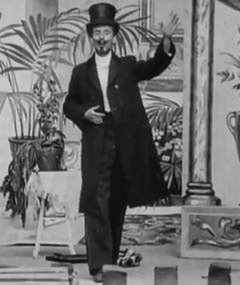
They were fresh off making a landmark in avant-garde cinema, the shocking Un Chien Andalou. That was a short film, but L'Age d'Or was closer to feature length at 63 minutes. Like Un Chien Andalou, there is no clear plot and events that take place appear to be random. Surrealism is an obvious influence and well-known Surrealist artist Max Ernst appears as an actor.
Buñuel was Spanish, but this was made in France and in the French language and premiered in Paris in 1930. The film caused an uproar as a conservative group called the League of Patriots tried to stop a screening by hurling ink at the screen and assaulting audience members. It was only a couple weeks before Paris banned any screenings of L'Age d'Or.
The controversy was so strong that it wasn't publicly shown in the United States until 1979. This was because of the sexual content as well as content that was considered blasphemous towards the Catholic Church and one of the producers was even threatened with excommunication. It's not surprising that the church found it sacrilegious as the film featured lots of religious iconography such as bishops and crucifixes.
There's even a reference to the infamous 18th-century novel 120 Days of Sodom by the Marquis de Sade with an intertitle that states "120 Days of Depraved Acts".
L'Age d'Or was easily one of the two most significant films on this list, what I'd consider to be the "essentials."
The other was made that same year when Jean Cocteau directed The Blood of a Poet. He began his career writing poetry, plays, and novels and became well known in the 1910s and 1920s. Cocteau made films from 1925 up until just a few years before his death in 1963, including a 1946 version of Beauty and the Beast.

The Blood of a Poet was the first part of Cocteau's Orphic trilogy, which had a second installment in 1950 with Orphée, and concluded in 1960 with Testament of Orpheus.
The Blood of a Poet contains a lot of odd imagery like a talking statue and a man jumping through a mirror. Like L'Age d'Or, there isn't an obvious plot or story. These factors lead many to call this is a Surrealist work, and they aren't entirely wrong. However, Cocteau himself said "surrealism did not exist when I first thought of [the film]" and that "The Blood of a Poet draws nothing from either dreams or symbols."
This film was quite controversial and wasn't allowed to be screened until 1932, with its first showing at a gala evening in Paris. This was partly because The Blood of a Poet was perceived as anti-Christian, another similarity it shared with L'Age d'Or.
A famous American photographer named Lee Miller appeared, and this would be the only time she'd ever be in a movie.
Cocteau's 55-minute long film also has some very impressive special effects and visual tricks for its time and is worth watching for this reason alone. The Blood of a Poet is clearly up there with L'Age d'Or as one of the must-see experimental movies of the decade.