THE AVENGERS
2012 was a massive year for comic book films. The biggest one of all was Marvel Studios' The Avengers.
Joss Whedon's film was an unprecedented culmination of 5 films starring 4 different characters. Suffice to say, something like this had never been done before. It was a risk on Marvel's part, but it paid off massively.
The Avengers is the third highest grossing movie of all time, making over 1.5 billion dollars. No other film has gotten to one billion as quickly. Obviously, it was a success with audiences, but it was also popular with critics and comic book fans. It didn't take itself super seriously like Nolan's Batman films but wasn't campy either. It found the perfect middle ground to deliver a very entertaining film. The Avengers even got an Academy Award nomination for best visual effects.
The main line up consisted of Iron Man, Captain America, Thor, and The Hulk. Supporting members included Black Widow, was introduced in Iron Man 2, and Hawkeye, who cameoed in Thor. Both characters are agents of SHIELD. They look similar to their "Ultimate" versions, but their personalities are closer to the 616 mainstream Marvel universe.
Most of the characters are portrayed by the same actors and actresses as the previous films, with one notable exception. Edward Norton, star of The Incredible Hulk, did not reprise his role. In his place was Mark Ruffalo as Bruce Banner. Many reasons have been given for this, such as Norton wanting too much control over production. Whatever the cause, it was probably for the best. Norton is more of a serious actor and might not have fit in with the more lighthearted tone of The Avengers.
The Avengers has been a highly influential film, especially in regards to comic adaptations. It has shown that using a "shared universe" can mean huge profits. Not long after it was released, Warner Brothers announced that they would be making a Justice League movie, which would involve DC Comics' biggest heroes teaming up. To the average viewer this may look like DC ripping off Marvel, despite the Justice League predating the Avengers.
The success of The Avengers has also seemingly influenced other studios that own Marvel properties. There are rumors that FOX will place the X-Men and the Fantastic Four in a shared universe with a potential crossover. Sony is also apparently to be headed in this direction. They are looking to create a mini shared universe with the Spider-Man characters, with a Sinister Six movie being rumored.
THE DARK KNIGHT RISES
The other massive comic book movie of 2012 was The Dark Knight Rises, the final entry in Christopher Nolan's epic trilogy.
In a way, this is was as unprecedented as The Avengers, in that it was really the first intended conclusion to a superhero film saga. Other series have always left it open ended for sequels.
It didn't make quite as big of a splash as its predecessor, but it made over $1 billion worldwide, with $448 million of that coming from the United States. This makes it the 3rd highest grossing superhero film and the tenth highest of all movies period. As of September 15th, it sits at number 51 on the IMDB top 250.
It is a very impressive film that stands up with the rest of the trilogy and has many of the same strengths and weaknesses of the previous two. All of them seem excellent your first time seeing them in the theater but don't hold up as well to repeat viewings.
Like the first two, The Dark Knight Rises suffers from some instance of clunky exposition, such as the scenes describing the "clean slate". I also thought it was rather obvious that Marion Cotillard's character would end up being a villain. Maybe I was biased having heard rumors that she would be Talia al Ghul, but I think her comments about bringing "balance to the world" kind of gave it away.
Furthermore, I'm not a big fan of they had Batman retired for 8 years. This does not seem very true to the character. Many dispute this, pointing out that Batman has been retired in certain comics before. But that was when Batman was old and had already been through multiple Robins. In this universe he was only active for a few years before quitting.
There were a few different comics that inspired the film. Perhaps the most significant was Knightfall, the story arc published from 1993 to 1994. Specifically, the scene where Bane breaks Batman's back is very reminiscent of the equivalent scene in the comics.
Another cited influence was Frank Miller's The Dark Knight Returns. It does the share the basic concept of a weakened Batman getting back into it. The 1999 storyline No Man's Land, where Gotham is cut off from the rest of the world, is also an inspiration.
THE AMAZING SPIDER-MAN
After the difficulties with Sam Raimi and the never-filmed Spider-Man 4, Sony decided to go with a reboot that ended up being polarizing among the hardcore fanbase.
I must admit that I was never a huge Spider-Man and I didn't have a vested interest in the character. I didn't get into the Raimi trilogy as it never seemed like my style. I found this version, directed by Marc Webb, more entertaining than previous trilogy.
Many things are similar to the Raimi films, with one interesting exception being that Andrew Garfield's version has mechanical webshooters that he made himself (like in the comics) as opposed to biological ones that are the result of his mutation.
Another major difference is that Mary Jane is not featured at all, with the character of Gwen Stacy(Emma Stone) in her place. The film also uses a villain that had not been seen on film before in The Lizard aka Curt Connors.
This film also sets up Oscorp, which comes into play in the second film, released in 2014.
The Amazing Spider-Man was a huge success, raking in over $750 million globally on a budget of $230 million (according to Wikipedia). The reviews were mostly positive as well.
DREDD
The character of Judge Dredd has been around since 1977, appearing in the British anthology 2000 A.D. He was created by artist John Wagner and artist Carlos Ezquerra.
Most simply know him from the Sylvester Stallone film, to the dismay of comic readers that are familiar with the more serious take. The 2012 version, directed by Pete Travis (Vantage Point) and starring Karl Urban, certainly takes the character more seriously. Fans generally consider this version to be truer to the spirit of the comics.
Box Office Mojo gives the worldwide gross at $35 million, while Wikipedia puts it at $41 million, Either way this doesn't even make back the reported budget of $45-50 million.
Critics however gave Dredd mostly positive reviews and it has found a bit of a cult following. A sequel was talked about, but it's future is uncertain at the moment.
GHOST RIDER: SPIRIT OF VENGEANCE
Finally, we come to easily the worst comic film of 2012. It was directed by the talentless directing duo that goes by Neveldine/Taylor. They are responsible for cinematic atrocities such as Crank, the sequel to Crank, Gamer, and Jonah Hex.
The Ghost Rider sequel didn't do well critically, but it made over a $130 million only a budget of less than $60 mil.
Despite this there are currently no plans for a third installment, Nicolas Cage even stated that he was done with the role.
In 2013, the rights went back to Marvel Studios. Due to the rather negative reaction to the first two from comic book fans, I don't think we will be seeing a standalone Ghost Rider movie anytime soon. The best fans of the character should hope for would be for him in to show up as a minor character somewhere in the MCU.
Follow me on Twitter at @KinoPravdaBlog or Facebook
Monday, September 15, 2014


Sunday, January 12, 2014
The History of Comic Book Adaptations to Film: Part Fifteen (2011)
THOR

Two new additions the Marvel Cinematic Universe were churned out in 2011. The first was Thor, based on the longtime Avenger. Thor was first seen in Marvel Comics in 1962, adapted from Norse mythology by Stan Lee, scripter Larry Lieber, and penciller Jack Kirby.
Thor was originally considered as a project by Sam Raimi in the early 1990s. This fell through and nothing more transpired on it until the early 2000s. Other directors considered were David S. Goyer and Matthew Vaughn.
Eventually, Marvel Studios chose Kenneth Branagh. Branagh is noted for having directed and starred in several well-received Shakespeare adaptations. To portray Thor, they chose relative newcomer Chris Hemsworth, surrounding him with big names such as Natalie Portman, Anthony Hopkins, and Rene Russo.
Thor connects to the greater MCU in multiple ways. It features a cameo by Hawkeye in his first cinematic appearance. Of course, Hawkeye would go on to play a large role in The Avengers. Then there's Agent Coulson, who appears here after being established in Iron Man and Iron Man 2. He even has a comment directed towards him asking if the Asgardian Destroyer armor is "one of Stark's". At one point, Dr, Selvig refers to a colleague that studied gamma radiation, AKA Bruce Banner AKA, The Hulk. There's also an after credit scene that sets up The Avengers.
The film stays generally faithful to the comic Thor but it sort of combines elements of the 616 and Ultimate versions. Thor doesn’t have his alter ego of Donald Blake, although this is briefly referred to when it is used as a false identity to break him out of SHIELD custody.
Thor did quite well. The budget was a moderate $150 million, and it totaled over $449 million in B.O. by the time everything was said and done. It was a critical success as well, earning itself a 77 percent on the good ol' Tomatometer.
Many comic fans consider it somewhat mediocre, but I think it's one of the best superhero films ever made. The visuals are amazing and Loki is easily in the top 5 villains from comic movies.
A sequel, Thor: The Dark World was released in November 2013. A third film is likely, hopefully featuring Surtur as the villain.
CAPTAIN AMERICA: THE FIRST AVENGER

The next entry in the MCU was Captain America: The First Avenger. Captain America was created in 1941 and the film stays true to his roots as a WWII-era character that gets frozen until modern times.
The First Avenger stars Chris Evans, Tommy Lee Jones, Hugo Weaving, and Toby Jones. It was directed by Joe Johnston, who also made Jumanji, The Rocketeer, and Jurassic Park III.
Evans had plenty of experience in comic adaptations prior to this. He appeared in the two Fantastic Four films, as well as The Losers and Scott Pilgrim vs. The World.
As with Thor, Marvel Studios decided to take aspects of the character from both the 616 and Ultimate continuities. The personality is similar to the 616 version (as opposed to the racist, jingoistic Ultimate version), but his appearance takes cues from the Ultimate Captain America.
Captain America's most famous nemesis, Red Skull was picked as the villain. As with many comic book movies, his code name isn't really used. The term "Red Skull" is only used once, and as an insult.
This was the last MCU film before The Avengers. Joss Whedon, the director of The Avengers, rewrote the script the include more references to the greater universe. The final product has a lot of connective tissue to the MCU. For example, this film introduces the Cosmic Cube, which is crucial to the plot of The Avengers.
Furthermore, Howard Stark, Tony's father, is a pretty significant character in CA: TFA. Thor is also referenced and Nick Fury appears at the end when the film skips ahead to the present.
The Marvel Studios effort was decently successful. It raked in over $370 million all told on a budget of only $140 million. It ended up being the third highest grossing movie that was set in World War Two. The critical reaction wasn't bad either. CA: TFA has a 79% at Rotten Tomatoes and a score of 66 on Metacritic.
A sequel is being released on April 4, 2014, titled Captain America: The Winter Solider. It will feature the return of Sebastian Stan. His character, Bucky Barnes, appeared to die in the first film. However, as in the comics, he survived to come back as the brainwashed villain known as the Winter Soldier.
X-MEN: FIRST CLASS

After mixed reactions to X-Men 3 and X-Men Origins: Wolverine, FOX was looking breathe fresh air into the franchise. To achieve this, they would go with a prequel that also could be seen as somewhat of a reboot. Most of the main characters from the main trilogy, like Storm, Jean Grey, Cyclops, and Rogue would not appear at all. Wolverine only had a quick cameo.
Instead the story would focus on the younger versions of Professor X (James McAvoy) and Magneto (Michael Fassbender). The story-line has some issues with previously established backstory of the original films, but it's clear these are supposed to be younger versions of McKellen and Stewart. A younger Mystique also appears, played by Jennifer Lawrence.
Director Matthew Vaughn reportedly only referred to the first two films in terms of continuity. Many issues seem to arise when comparing First Class to X-Men 3 or Origins. In The Last Stand, Magneto and a bald, able-bodied Charles Xavier meet Jean Grey as a child. However, in this film, they have their falling out in the 1960s before Jean is even born and Xavier gets his injury as a younger man who still has hair.
Furthermore, we have Emma Frost, who appeared as a teenager in Origins, which is set decades after First Class where she shows up as an adult woman played by January Jones.
Quality-wise, the film is one of the better entries in the X-Men franchise. Fassbender and McAvoy are both really good in the leads. First Class was a modest success at the box office, making over $350 million. Decent, but perhaps not the massive success FOX was looking for.
The cast of this film will be in the same movie as the original actors next spring in X-Men: Days of Future Past.
GREEN LANTERN
The biggest comic book movie misstep of 2011 came from DC. When it came to movies, DC was known for being reliant on Superman and Batman, and still is in some respects. The only live action film that was based on a DC character before 1997 besides the big two was Swamp Thing, and that was pretty low budget. 1997 saw the release of Steel, which was a massive failure. There were no DC movies until 2004's Catwoman, which was also terrible. The only other DC characters to get film adaptations were Watchmen (kind of an exception as it was based on the famed Alan Moore graphic novel) and Jonah Hex, a minor character that flopped at the box office.
DC still hadn't made a film out of most of its major characters, such as Wonder Woman, The Flash, and Green Lantern. Marvel was a bit slower out of the gate than DC, but by 2011, many major Marvel characters had films (Spider Man had 3, X-Men had 5, the Fantastic Four and the Hulk each had 2). Even many minor characters had been adapted. Blade had a trilogy, Iron Man had 2 movies, Thor had one, hell even Elektra and Ghost Rider had big screen versions.
DC needed to catch up, and fast. So they went with one of their heavy hitters that had never been seen on screen, Green Lantern. Green Lantern was supposed to start a DC cinematic universe the way that Iron Man did for Marvel films. Sadly, Green Lantern flopped and this didn't take place. The role of the kickstarter for the shared universe went to the 2013 film Man of Steel.
Green Lantern had been one of the major players in the DC universe for decades. The original Green Lantern was Alan Scott, but Hal Jordan became more well known. The character of Green Lantern became known partly through his animated appearances. Hal appeared in the 1960s cartoon, The Superman/Aquaman Hour of Adventure. Another Green Lantern, John Stewart had a very significant role in the animated Justice League and Justice League Unlimited shows.
COWBOYS AND ALIENS
Finally we come to Cowboys and Aliens, based on the 2006 graphic novel of the same name. It was written by Scott Mitchell Rosenberg, Fred Van Lente, and Andrew Foley, and illustrated by Dennis Calero.
The movie version was made by Iron Man and Iron Man 2 director Jon Favreau. The cast included Harrison Ford, Olivia Wilde, and Daniel Craig. It was somewhat of a flop, barely making more than the budget at the box office.
Follow me on Twitter at @KinoPravdaBlog or Facebook

Two new additions the Marvel Cinematic Universe were churned out in 2011. The first was Thor, based on the longtime Avenger. Thor was first seen in Marvel Comics in 1962, adapted from Norse mythology by Stan Lee, scripter Larry Lieber, and penciller Jack Kirby.
Thor was originally considered as a project by Sam Raimi in the early 1990s. This fell through and nothing more transpired on it until the early 2000s. Other directors considered were David S. Goyer and Matthew Vaughn.
Eventually, Marvel Studios chose Kenneth Branagh. Branagh is noted for having directed and starred in several well-received Shakespeare adaptations. To portray Thor, they chose relative newcomer Chris Hemsworth, surrounding him with big names such as Natalie Portman, Anthony Hopkins, and Rene Russo.
Thor connects to the greater MCU in multiple ways. It features a cameo by Hawkeye in his first cinematic appearance. Of course, Hawkeye would go on to play a large role in The Avengers. Then there's Agent Coulson, who appears here after being established in Iron Man and Iron Man 2. He even has a comment directed towards him asking if the Asgardian Destroyer armor is "one of Stark's". At one point, Dr, Selvig refers to a colleague that studied gamma radiation, AKA Bruce Banner AKA, The Hulk. There's also an after credit scene that sets up The Avengers.
The film stays generally faithful to the comic Thor but it sort of combines elements of the 616 and Ultimate versions. Thor doesn’t have his alter ego of Donald Blake, although this is briefly referred to when it is used as a false identity to break him out of SHIELD custody.
Thor did quite well. The budget was a moderate $150 million, and it totaled over $449 million in B.O. by the time everything was said and done. It was a critical success as well, earning itself a 77 percent on the good ol' Tomatometer.
A sequel, Thor: The Dark World was released in November 2013. A third film is likely, hopefully featuring Surtur as the villain.
CAPTAIN AMERICA: THE FIRST AVENGER
The next entry in the MCU was Captain America: The First Avenger. Captain America was created in 1941 and the film stays true to his roots as a WWII-era character that gets frozen until modern times.
The First Avenger stars Chris Evans, Tommy Lee Jones, Hugo Weaving, and Toby Jones. It was directed by Joe Johnston, who also made Jumanji, The Rocketeer, and Jurassic Park III.
Evans had plenty of experience in comic adaptations prior to this. He appeared in the two Fantastic Four films, as well as The Losers and Scott Pilgrim vs. The World.
As with Thor, Marvel Studios decided to take aspects of the character from both the 616 and Ultimate continuities. The personality is similar to the 616 version (as opposed to the racist, jingoistic Ultimate version), but his appearance takes cues from the Ultimate Captain America.
Captain America's most famous nemesis, Red Skull was picked as the villain. As with many comic book movies, his code name isn't really used. The term "Red Skull" is only used once, and as an insult.
This was the last MCU film before The Avengers. Joss Whedon, the director of The Avengers, rewrote the script the include more references to the greater universe. The final product has a lot of connective tissue to the MCU. For example, this film introduces the Cosmic Cube, which is crucial to the plot of The Avengers.
Furthermore, Howard Stark, Tony's father, is a pretty significant character in CA: TFA. Thor is also referenced and Nick Fury appears at the end when the film skips ahead to the present.
The Marvel Studios effort was decently successful. It raked in over $370 million all told on a budget of only $140 million. It ended up being the third highest grossing movie that was set in World War Two. The critical reaction wasn't bad either. CA: TFA has a 79% at Rotten Tomatoes and a score of 66 on Metacritic.
A sequel is being released on April 4, 2014, titled Captain America: The Winter Solider. It will feature the return of Sebastian Stan. His character, Bucky Barnes, appeared to die in the first film. However, as in the comics, he survived to come back as the brainwashed villain known as the Winter Soldier.
X-MEN: FIRST CLASS
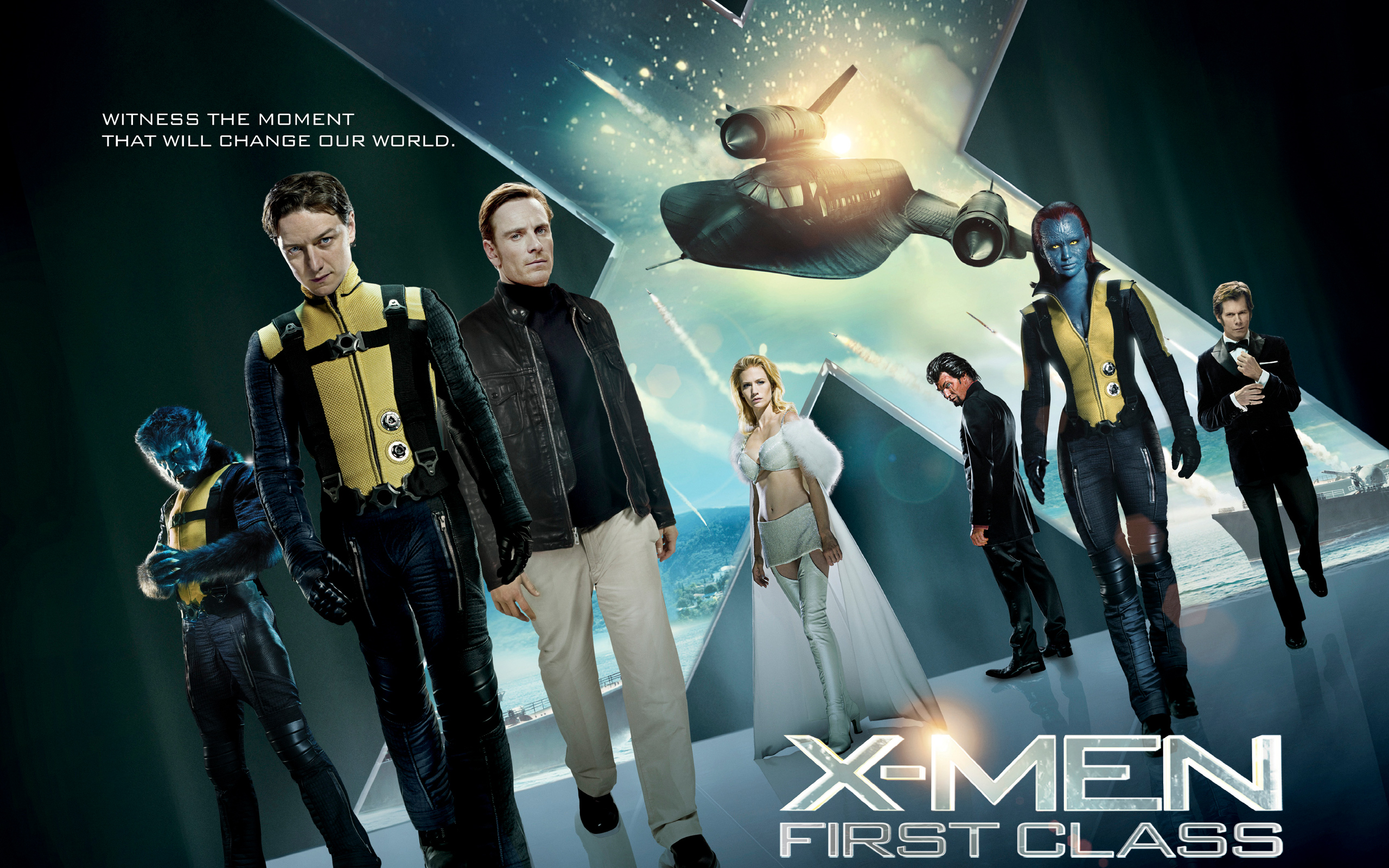
After mixed reactions to X-Men 3 and X-Men Origins: Wolverine, FOX was looking breathe fresh air into the franchise. To achieve this, they would go with a prequel that also could be seen as somewhat of a reboot. Most of the main characters from the main trilogy, like Storm, Jean Grey, Cyclops, and Rogue would not appear at all. Wolverine only had a quick cameo.
Instead the story would focus on the younger versions of Professor X (James McAvoy) and Magneto (Michael Fassbender). The story-line has some issues with previously established backstory of the original films, but it's clear these are supposed to be younger versions of McKellen and Stewart. A younger Mystique also appears, played by Jennifer Lawrence.
Director Matthew Vaughn reportedly only referred to the first two films in terms of continuity. Many issues seem to arise when comparing First Class to X-Men 3 or Origins. In The Last Stand, Magneto and a bald, able-bodied Charles Xavier meet Jean Grey as a child. However, in this film, they have their falling out in the 1960s before Jean is even born and Xavier gets his injury as a younger man who still has hair.
Furthermore, we have Emma Frost, who appeared as a teenager in Origins, which is set decades after First Class where she shows up as an adult woman played by January Jones.
Quality-wise, the film is one of the better entries in the X-Men franchise. Fassbender and McAvoy are both really good in the leads. First Class was a modest success at the box office, making over $350 million. Decent, but perhaps not the massive success FOX was looking for.
The cast of this film will be in the same movie as the original actors next spring in X-Men: Days of Future Past.
GREEN LANTERN
The biggest comic book movie misstep of 2011 came from DC. When it came to movies, DC was known for being reliant on Superman and Batman, and still is in some respects. The only live action film that was based on a DC character before 1997 besides the big two was Swamp Thing, and that was pretty low budget. 1997 saw the release of Steel, which was a massive failure. There were no DC movies until 2004's Catwoman, which was also terrible. The only other DC characters to get film adaptations were Watchmen (kind of an exception as it was based on the famed Alan Moore graphic novel) and Jonah Hex, a minor character that flopped at the box office.
DC still hadn't made a film out of most of its major characters, such as Wonder Woman, The Flash, and Green Lantern. Marvel was a bit slower out of the gate than DC, but by 2011, many major Marvel characters had films (Spider Man had 3, X-Men had 5, the Fantastic Four and the Hulk each had 2). Even many minor characters had been adapted. Blade had a trilogy, Iron Man had 2 movies, Thor had one, hell even Elektra and Ghost Rider had big screen versions.
DC needed to catch up, and fast. So they went with one of their heavy hitters that had never been seen on screen, Green Lantern. Green Lantern was supposed to start a DC cinematic universe the way that Iron Man did for Marvel films. Sadly, Green Lantern flopped and this didn't take place. The role of the kickstarter for the shared universe went to the 2013 film Man of Steel.
Green Lantern had been one of the major players in the DC universe for decades. The original Green Lantern was Alan Scott, but Hal Jordan became more well known. The character of Green Lantern became known partly through his animated appearances. Hal appeared in the 1960s cartoon, The Superman/Aquaman Hour of Adventure. Another Green Lantern, John Stewart had a very significant role in the animated Justice League and Justice League Unlimited shows.
COWBOYS AND ALIENS
Finally we come to Cowboys and Aliens, based on the 2006 graphic novel of the same name. It was written by Scott Mitchell Rosenberg, Fred Van Lente, and Andrew Foley, and illustrated by Dennis Calero.
The movie version was made by Iron Man and Iron Man 2 director Jon Favreau. The cast included Harrison Ford, Olivia Wilde, and Daniel Craig. It was somewhat of a flop, barely making more than the budget at the box office.
Follow me on Twitter at @KinoPravdaBlog or Facebook
Sunday, December 29, 2013
The Wolf of Wall Street (9/10)
The Wolf of Wall Street is yet another amazing film from one of the best directors of all-time, Martin Scorsese. I'd say it's easily his best since the 2006 flick The Departed.
The Wolf of Wall Street is the fifth collaboration between Scorsese and Leonardo DiCaprio and DiCaprio's performance in this film is nothing short of astounding. He plays Jordan Belfort, a stockbroker who made millions but eventually served time in prison for fraud. Belfort is a real person and the film is based on his memoir. Terence Winter, who worked with Scorsese on Boardwalk Empire, wrote the script.
DiCaprio carries the movie on his shoulders, but the supporting performances are all solid as well. Jonah Hill is great as Belfort's right hand man and Matthew McConaughey is surprisingly effective in a role that basically amounts to an extended cameo.
Scorsese doesn't shy away from showing the sexual and drug-related excesses that went along with Belfort's riches and this had led many to complain that the film is glorifying criminal behavior. However, this seems to be missing the point.
Firstly, no one should be surprised at this point that a Scorsese film features immoral acts shown in an entertaining way. Also, the very final shot of the film showing an enraptured audience at one of Belfort's motivational talks seems to be indicting the film's viewers for this kind of thinking. And there are several moments that make it clear that Belfort is not that sympathetic of a character.
There's also been a fair amount of controversy of the sexual content. Some have felt that the film should have been rated NC-17. There are quite a bit of sexual scenes, but none of them really go past what could be acceptable in an R-Rated movie. Undoubtedly, Scorsese also has some pull with the MPAA and got away with more than an up and coming filmmaker could. Reportedly he did have to make some cuts in order to avoid the NC-17 rating, which would have severely hurt the box office take.
The Wolf of Wall Street also features 506 uses of the word "fuck". According to Wikipedia, this is by far the most uses of that word in a non-documentary, non-pornographic film.
So far, the movie has made over $34 million worldwide since its release on Christmas Day. The reviews have been mostly positive; the Rotten Tomatoes score is currently at 76% and the Metacritic rating is a similar 75 out of 100.
RATING: 9/10
Follow me on Twitter at @KinoPravdaBlog or Facebook
The Wolf of Wall Street is the fifth collaboration between Scorsese and Leonardo DiCaprio and DiCaprio's performance in this film is nothing short of astounding. He plays Jordan Belfort, a stockbroker who made millions but eventually served time in prison for fraud. Belfort is a real person and the film is based on his memoir. Terence Winter, who worked with Scorsese on Boardwalk Empire, wrote the script.
DiCaprio carries the movie on his shoulders, but the supporting performances are all solid as well. Jonah Hill is great as Belfort's right hand man and Matthew McConaughey is surprisingly effective in a role that basically amounts to an extended cameo.
Scorsese doesn't shy away from showing the sexual and drug-related excesses that went along with Belfort's riches and this had led many to complain that the film is glorifying criminal behavior. However, this seems to be missing the point.
Firstly, no one should be surprised at this point that a Scorsese film features immoral acts shown in an entertaining way. Also, the very final shot of the film showing an enraptured audience at one of Belfort's motivational talks seems to be indicting the film's viewers for this kind of thinking. And there are several moments that make it clear that Belfort is not that sympathetic of a character.
There's also been a fair amount of controversy of the sexual content. Some have felt that the film should have been rated NC-17. There are quite a bit of sexual scenes, but none of them really go past what could be acceptable in an R-Rated movie. Undoubtedly, Scorsese also has some pull with the MPAA and got away with more than an up and coming filmmaker could. Reportedly he did have to make some cuts in order to avoid the NC-17 rating, which would have severely hurt the box office take.
The Wolf of Wall Street also features 506 uses of the word "fuck". According to Wikipedia, this is by far the most uses of that word in a non-documentary, non-pornographic film.
So far, the movie has made over $34 million worldwide since its release on Christmas Day. The reviews have been mostly positive; the Rotten Tomatoes score is currently at 76% and the Metacritic rating is a similar 75 out of 100.
RATING: 9/10
Follow me on Twitter at @KinoPravdaBlog or Facebook
Monday, December 23, 2013
American Hustle is David O. Russell's best
The newest film from director David O. Russell, American Hustle, is easily his most mature work. Russell also directed Three Kings, I Heart Huckabees, The Fighter, and Silver Linings Playbook. Most of his previous films were solid, but none reached the heights of Hustle.
As usual with David O. Russell, there's a strong ensemble cast. The main character is con-man Irving Rosenfeld, played by a transformed Christian Bale. Bale gained what looked to be a decent amount of weight for the role and has an obnoxious comb-over. He does an excellent job of creating sympathy for what might otherwise have been an alienating character. This is Bale's second collaboration with Russell, after starring in The Fighter. Rosenfeld's wife Rosalyn is played effectively by Jennifer Lawrence and Amy Adams portrays his partner/lover Sydney.
They con people out of thousands using the promise of loan for more, until they get caught by an FBI agent, played by Bradley Cooper with a perm. His boss is comedian Louis C.K. who does very well in a small role. Cooper's agent forces Rosenfeld and Sydney to assist him in taking down other con men and corrupt politicians. Jeremy Renner appears as the politician they're trying to take down. There's even a small surprise cameo from none other than Robert Deniro, who was uncredited and not mentioned in any of the advertising.
The movie is based on a true story, but many details have been altered, including the names of the characters. As onscreen text indicates at the very beginning, "Some of this actually happened."
As previously mentioned, American Hustle is more mature than Russell previous works, and has a distinct style. The cinematography is excellent, and a bit slower than usual for Russell. He seems to be taking cues from P.T. Anderson. Russell also strikes an interesting tone; the film can be quite funny, but I wouldn't call it a comedy. Hustle is definitely one of the best of the year. It deserves, and will probably garner, a Best Picture nomination. However, it's not quite as good as the absolute best of the year, such as 12 Years a Slave or Gravity.
American Hustle is getting excellent reviews and currently has a 94% rating on Rotten Tomatoes. At the box office, it's made slightly over $20 million.
Monday, December 16, 2013
Please follow me on instagram at lordofthewalri
Hey, please take a second to follow my instagram account at http://instagram.com/lordofthewalri
Here's some examples of pics you'll find:


Here's some examples of pics you'll find:


Wednesday, November 20, 2013
Cable News Networks and Bias (Part 2)
What about
CNN? There are plenty of examples of bias on that network as well. According to
First Things, when CNN reported on a Tea Party event that actually had
hundreds, if not thousands, of attendees, they said that there were only, “at
least dozens of people” (Hoft, 2010). The Tea Party is closely associated with
conservatives, so this supports the notion that CNN has a liberal bias.
A Harvard study found that during
the primaries for the 2008 election, “The CNN programming studied tended to
cast a negative light on Republican candidates—by a margin of three-to-one.”
(“Invisible Primary”, 2007) It also stated that Hillary Clinton and John
Edwards got slightly better coverage, but still mostly negative, “almost all
due to extremely favorable coverage for Obama.” CNN seems to be in the same
pro-Obama camp as MSNBC.
In 2009, a former CNN correspondent
named Chris Plante that conservative commentator Lou Dobbs left because of
CNN's liberal bias and that “his opinions are out of lockstep with the rest of
the mainstream news media” (“Former CNN”, 2009.). Plante also claimed that the
last “conservative voice on the channel is gone.” since Glenn Beck and Dobbs
left.
The website Rightpundits.com gave an
example that they feel proves that CNN is left-leaning.(“Jill Zimon”, 2008).
CNN presented a blogger named Jill Zimon, who is an admitted liberal, as a
moderate. The site produced an email that showed that Zimon told CNN that she
“leaned left”.
An article from the Business and
Media Institute examines CNN”s coverage of global warming (Gainor and Menefee,
2005). It claimed that a special from March 2005, “cited almost every one of
the left-wing environmental movement's hot buttons about climate change:
claiming it's already a fact; preaching an apocalyptic threat; blaming mankind
for temperature fluctuations...”
However, some liberals have pointed
out examples of a conservative bias on CNN. Media Matters ran an article
demonstrating how the media, including CNN, “advanced the false talking point
that oil drilling is environmentally safe because "not one drop of oil was
spilled" during Hurricane Katrina.” (“Flashback”, 2010). CNN's Ali Velshi
stated that oil rigs were sealed to stop oil leakage during storms, and that
this worked during Hurricane Katrina. Then there was a “massive oil spill
discharging 5,000 barrels/day into Gulf of Mexico.” CNN, just like every other
network, is controlled by corporate interests. Therefore, the stations are
unlikely to present ideas that may cause large corporations to lose money.
During the Iraq War, the media was
supportive of the Bush administration and didn't ask too many difficult
questions. As quoted in Socialist Worker Online, CNN reporter Christiane
Amanpour referred to the press as being “self-muzzled” and said, “Television
was intimidated by the Bush administration and its foot soldiers at Fox News”
(Selfa, 2003). No one, even liberals, wanted to be seen as unpatriotic after
the 9/11 terrorist attacks. For a couple of years, the Bush administration had
a free pass in the media.
Democracy Now quoted Michael Moore,
who criticized CNN's coverage of the Iraq War (“Michael Moore”, 2007). He
claimed that they wrote off his movie, Fahrenheit 9/11. The movie stated
that the war would end up becoming a “quagmire” and that there were no weapons
of mass destruction. Moore said that CNN made it seem like none of these things
could be true; reality ended up vindicating Moore. He also claims that CNN
misleads its viewers when it comes to healthcare.
Fox News consistently gets better
ratings than MSNBC or CNN. In an article for TV Week, Sergio Ibarra said, “Fox
News averaged 2.3 million viewers during primetime in the first quarter [of
2008), according to Nielsen Media Research. CNN averaged 1.1 million viewers,
while MSNBC had about 950,000” (Ibarra, 2009). This shows that Fox News is
popular, possibly because it goes for the lowest common denominator. The
article also states that Fox News did the best in the age 25-54 demographic,
which is one of the most important demographics to advertisers. The O'Reilly
Factor, as well as Hannity's and Beck's shows were the most popular programs. They
are also the programs that contain lots of opinion statements.
When it comes down to it, none of
the stations are going to present ideas that are highly controversial or
challenging to the status quo. There's just not enough profit in it. Many
people think that the media is liberally biased because many journalists are
left-wing. However, media editors and owners, who have much more power, are
more likely to be conservative.
The lower-level employees often try
to bring their views in line with their superiors in order to help their
career. Making money is more important to media companies than presenting any
particular point of view. It just so happens that conservatives viewpoints
often benefit large corporations.
Republicans are usually in favor of deregulation
of business and the free market. Liberals often want some checks on
corporations. Which perspective is going to be presented in the corporate-owned
media? Obviously the one that supports the bottom line. Additionally, stations
receive pressure from advertisers to tow the line. For example, many advertisers refused to run ads on Air
America, the liberal radio station.
All the networks are part of large
conglomerates. NBC is owned by General Electric and Disney (the world's largest
media conglomerate) owns ABC. Most local radio and TV stations are owned by
companies that own hundreds of other stations. There used to be tighter
regulations concerning these matters, but the Telecommunications Act of 1996
changed this. These companies are unlikely to want to upset those in power.
Maybe to get out of this biased system, some more publicly funded news networks
or outlets are needed.
These problems are just part of a
much larger issue. The news networks have become increasingly more
sensationalistic. They will often do stories on celebrities. This is just a
distraction from what is really important. When Anna Nicole Smith died, there
was coverage round-the-clock over the circumstances of her death. This, all
over someone who was famous for no legitimate reason and really had no
important position in life. These so-called “news” programs often discuss the
personal lives of athletes or movie stars. When Tiger Woods cheated on his
wife, it was one of the biggest stories. These kinds of stories are a distraction
from what is really important. Many Americans have no idea what's going on in
foreign countries, but they know about the relationships of celebrities. People
won't be upset at those in power if they are thinking about trivial matters.
Furthermore, these cable news
networks often run stories on missing women. It's unfortunate that these women
are killed or kidnapped, but this isn't really a pressing issue on society. Not
to the mention the fact that the missing women that are covered are almost always
Caucasian. According to a CNN article, “When pretty, young women – especially
white ones – are killed or disappear, media storms often follow... Media and
social critics call the wall-to-wall coverage that seems to swirl around these
events, “Missing White Woman Syndrome” (Foreman, 2006). The news stations seem
to be more concerned with entertainment than actually getting across
information.
The way TV news is set up makes it
highly difficult to get out ideas that are
out of the mainstream. Usually segments are only a few minutes and
interviews are short as well. That's not
really enough time to present a cogent, detailed argument. Ideas that challenge
the mainstream way of thinking may seem ridiculous at first, but if their
proponents are given the chance to present evidence, they will be more
convincing. However, this doesn't happen on cable news channels. Especially on
Fox News, where hosts such as Bill O'Reilly often shout down guests and tell
them to “shut up”.
The documentary Outfoxed showed how
O'Reilly had a guest on, named Jeremy Glick, whose father had died in the
September 11th terrorist attacks. He claimed that Bush had inherited
a legacy from his father, who led the CIA when it trained al-Qaeda. O'Reilly
shouted him down several times, told him to shut up, and claimed that the man's
recently deceased father would not have approved of what the man was saying. He
doesn't even seem to consider the possibility that there is some credence to
what Glick is saying.
The documentary also demonstrated
how Fox News consistently uses fear tactics. They would play up terrorism
fears, with stories on anthrax scares that only affected a small amount of
people. The film claims that Fox also used similar tactics concerning gay
rights and immigration. This fear then leads to people wanting a strong
government and national defense.
Outfoxed pointed out several other
ethical violations. Their anchors often use the phrase, “Some people say...” as
a way of distancing themselves from the unsourced allegations they are about to
make. Usually these “some people” are attacking liberals. They referred to
suicide bombers as “homicide bombers” in order to make them seem less noble,
even though all bombers are committing homicide and what makes these people
unique is that they are taking their own lives in addition. Fox News also spent
a lot of time attacking Richard Clarke, a former Bush administration official
who later criticized the way that the administration handled the Iraq War.
However, the documentary could be accused
of being one-sided as well. No one interviewed in the movie denied Fox's bias.
The makers of the film obviously have an axe to grind. Outfoxed also contains
many clips that are very short and could be taken out of context.
Fox News has been the subject of a
massive amount of criticism. There have been many studies done, many by liberal
groups, that document the station's conservative bias. Fox News has become the
favored target of many on the left. Many of their anchors or hosts are avowed
conservatives. John Moody handed down several memos that encouraged employees
to support the Bush administration. Fox
News is more likely to hire conservatives and many Fox personalities regularly
raise funds for the GOP. Most TV viewers see Fox News as conservative, but
Rupert Murdoch and other employees deny that they are partisan. Studies have
found some differing conclusions about how the station effects voter behavior,
but there is some evidence it causes them to vote for Republicans.
A study has shown that Fox News viewers are
more likely to hold misconceptions about the Iraq War. Some people have claimed
that MSNBC and CNN are just as biased as Fox News. Conservatives claim that CNN
is liberal, while some lefties say it has a right-wing, pro-corporate slant.
Most of the mainstream media gave Bush a pass after 9/11. These outlets are all
owned by powerful corporations that have a vested interest in maintaining the
status quo. The way that these shows are formatted helps keep the status quo
intact as well.
References
Ackerman,
S. (2001, August). The Most Biased
Name in News. Retrieved May 1, 2010, from www.fair.org/index.php?page=1067
Cable TV:
Content Analysis. (2005). Retrieved April 6, 2010, from www.stateofthemedia.org/2005/narrative_cabletv_contentanalysis.asp?cat=2&media=5
Calderone,
M. (2008, August 24). Rendell: Obama
coverage was embarassing. Retrieved April 10, 2010, from politico.com/blogs/michaelcalderone/0808/Rendell_Obama_coverage_was_embarrassing.html
DellaVigna,
S., & Kaplan, E. (2006, March 30). The
Fox News Effect: Media Bias and Voting. Retrieved
May 1, 2010, from www.elsa.berkeley.edu/~sdellavi/wp/foxvote06-03-30.pdf
Dimiero,
B., Holden, J., & Maloy, S. (2010, April 23). Media Matters: Fox News' ever-expanding
ethics nightmare. Retrieved April 25, 2010, from
mediamatters.org/columns/201004230046
FLASHBACK: Media advanced falsehood that drilling is safe
because no oil spilled during Hurricane Katrina. (2010, April 29). Retrieved April 30, 2010, from mediamatters.org/research/201004290040
Foreman,
T. (2006, March 14). Diagnosing
'Missing White Woman Syndrome. Retrieved May 1, 2010, from
www.cnn.com/CNN/Programs/anderson.cooper.360/blog/2006/03/diagnosing-missing- white-woman.html
Former CNN Correspondent Claims CNN’s Liberal Bias Caused
Dobbs’ Exit. (2009, November 16). Retrieved May 1, 2010, from
theamericano.com/2009/11/16/former-cnn-correspondent-claims- cnns-liberal-bias-caused-dobbs-exit/
Fox News
Nailbiter!. (2008, November 5). Retrieved April 1, 2010, from www.fair.org/index.php? page=3643
Fox News Viewed as Most Ideological Network. (2009, October 29). Retrieved April 20, 2010, from www.people-press.org/report/559/
Gainor,
D., & Menefee, A. (2005, March 28). CNN’s Global Warming Special Typifies Liberal Bias of Climate Coverage. Retrieved April 1,
2010, from www.businessandmedia.org/news/2005/news20050328.asp

Hoft, J.
(2010, March 27). CNN on Size of
Searchlight Tea Party Rally: “Hundreds of People, At Least Dozens”. Retrieved May 1, 2010, from gatewaypundit.firstthings.com/2010/03/cnn-on-size-of- todays-searchlight-tea-party-rally-hundreds-of-people-at-least-dozens/
Ibarra, S.
(n.d.). CNN Ratings Down; Fox, MSNBC
Grow. Retrieved April 15, 2010, from www.tvweek.com/news/2009/03/cnn_ratings_down_fox_msnbc_gro.php
Interview transcript: Rupert Murdoch and Roger Ailes. (2006, October 6). Retrieved May 1, 2010, from
www.ft.com/cms/s/2/5b77af92-548c-11db-901f-0000779e2340.htmld
The Invisible Primary.
(2007, October 29). Retrieved May 1, 2010, from www.hks.harvard.edu/presspol/publications/reports/invisible_primary_invisible_no_longer.pdf
Jill Zimon Proves Liberal Bias at CNN. (2008, February 25). Retrieved April 18, 2010, from www.rightpundits.com/?p=1184
Krueger,
A. B. (2005, August 18). Fair? Balanced?
A Study Finds It Does Not Matter. Retrieved May 1, 2010, from
www.nytimes.com/2005/08/18/business/media/18scene.html
Kurtz, H.
(2008, May 28). MSNBC, Leaning Left
And Getting Flak From Both Sides. Retrieved April 20, 2010, from www.washingtonpost.com/wp-dyn/content/article/2008/05/27/AR2008052703047_pf.html
Maloy, S.
(2009, December 8). Fox News fiddles
with climate change polling. Retrieved April 16, 2010, from www.mediamatters.org/blog/200912080002
Martin,
V. B. (2008, September 26). Media Bias:
Going beyond Fair and Balanced. Retrieved April 12, 2010, from
www.scientificamerican.com/article.cfm?id=media-bias-presidential-election
Michael Moore “Blitzes” CNN’s Coverage of
Iraq War, Healthcare in Live Wolf Blitzer Interview. (2007, July
11). Retrieved April 18, 2010, from www.democracynow.org/2007/7/11/michael_moore_blitzes_cnns_coverage_of
News Corp Denies Fox News Bias. (2004, October 26). Retrieved April 30, 2010, from www.theage.com.au/articles/2004/10/26/1098667750250.html
Noah,
T. (2005, May 31). Fox News admits
bias!. Retrieved April 20, 2010, from http://www.slate.com/id/2119864/
Perez-Pena,
R. (2009, September 13). Trust in News Media Falls to New Low in Pew
Survey. Retrieved May 1, 2010, from
www.nytimes.com/2009/09/14/business/media/14survey.html
Rendall,
S. (2009, December). Fox News—Wing of the GOP?. Retrieved April 23, 2010,
from www.fair.org/index.php?page=3957
Rendall,
S. (2001, July). Fox's Slanted
Sources. Retrieved April 29, 2010, from www.fair.org/index.php?page=1072
Selfa, L.
(2003, October 3). How the media
sold Bush's war. Retrieved May 1, 2010, from s socialistworker.org/2003-2/470/470_09_MediaMuzzle.shtml
Steinberg,
J. (2007, November 6). Cable Channel Nods to Ratings and Leans Left.
Retrieved April 10, 2010, from
www.nytimes.com/2007/11/06/business/media/06msnb.html? _r=3&oref=slogin&pagewanted=print&oref=slogin
Weisberg,
J. (2009, October 17). The O'Garbage
Factor. Retrieved April 20, 2010, from www.newsweek.com/id/218192
Cable News Networks and Bias (Part 1)
In the past decade, many more people have been getting their news from 24-hour cable news networks. This is in great contrast to earlier times, when TV viewers only had the half-hour nightly news programs to watch. The main American news networks are FOX News, MSNBC, and CNN.
These networks are often much more ideological than the traditional news programs. They often take after talk-radio political programs such as Rush Limbaugh. CNN and MSNBC are often criticized for having a liberal bias, while FOX News is seen as right-wing.
This paper will examine whether or not these perceptions have basis in reality. It will also examine what effect these potential biases have on viewers. Does biased reporting damage the political discourse? Does it simply encourage bickering between the two sides?
FOX News is often the target of those decrying media bias. It first aired in 1996, and it was created by Rupert Murdoch. Murdoch made Roger Ailes, who worked for Nixon, Reagan and George H.W. Bush, the CEO of FOX News. Ailes was also a former NBC executive.
The station often uses flashy graphics that contain patriotic symbols such as the American flag. They are usually colorful and attention-grabbing.
Fox News also has a radio station that syndicated throughout the US. They recently added a satellite radio station as well.
Many people have noted that FOX News seems to have a conservative bias. Two of the most popular figures on the network, Sean Hannity and Glenn Beck clearly espouse conservative views. Hannity is right-wing, one of his books was titled, “Conservative Victory: Defeating Obama’s Radical Agenda." Beck often refers to Obama and his policies as "socialist" or "radical". He compared churches that fought for social justice to Hitler and Stalin in an episode of his show.
Subscribe to:
Posts (Atom)