Punch-Out!! is one of Nintendo's smaller video game franchises, but it still has a soft spot in the hearts of many gamers. Most people know the cartoony boxing series for its games on Nintendo's home consoles, but it actually started out in the arcades.
The first game in the series, simply called Punch-Out!! was released in Japanese arcades in 1983 and it came to the western world in 1984.
The single player game was produced by Genyo Takeda, who had been working for Nintendo since 1972. In 1975, he made their first ever arcade title, called EVR Race (assuming you don't count Laser Clay Shooting System).
The VHS format was massively popular and influential and it changed the way people watch movies. VHS's successor, the DVD, was not quite as much of a game changer, but it still had a huge impact on the home video market.
DVD came on the scene in the late 1990s, but the story actually begins in the early 1960s. In 1961, optical recording technology was patented by David Paul Gregg and James Russell. It wasn't until the 70s that progress was seen on this front and in 1978 the Laserdisc format was released. Laserdisc was the major predecessor to DVDs, but it never really gained widespread popularity, due to its numerous drawbacks. The discs were massive and you couldn't even fit a whole movie on one side of a disc. Laserdisc never challenged the dominance of VHS.
In 1986, Warner Home Video started saying that a new format should be developed where movies were stored on a five-inch optical disc like a Compact Disc used for music. The next year in 1987, another precursor to the DVD came out, the CD Video format. This was a sort of amalgamation of CD and Laserdisc technology. It didn't go over well (partially because of very small storage size) and was basically gone by 1991.
However, a similarly titled Video CD format was released in 1993. It was a bit more popular than CD Video, especially in Southeast Asia, but it still never really caught on. A major problem with the format was that there was no way of stopping people from making illegal copies.
As the Video CD was coming out, a group of companies that included Warner, Pioneer, JVC, Toshiba and others was working out a new home video format they were calling the Super Density Disc.
The only problem was that the Philips corporation had the rights to some very important patents regarding optical discs that could be useful. Warner, Toshiba, and the others reached out to Philips to get them to collaborate on the project.
However, Philips had other ideas and they started working on their own project with Sony called the Multimedia Compact Disc. The stage was set for another format war just like VHS versus Betamax.
Horror has been one of the most powerful and popular genres throughout film history and horror movies have been around since the earliest years of cinema.
Most commonly cited as the first horror movie is The Haunted Castle (Le Manoir du diable in French), a short by influential French filmmaker Georges Méliès. Due to his innovations in special effects and filming techniques, he was easily one of the most important early filmmakers. Méliès was more well-known for making some of the first science fiction shorts, including A Trip to the Moon and The Impossible Voyage.
The Haunted Castle was released in 1896, only eight years after the first film was made. The three-minute short starts off with a bat transforming into a human in front of the audience's eyes, basically making it the first vampire flick as well.
This was pulled off with Méliès' famous substitution splice trick where he would carefully match up two frames in order to give the illusion that one thing had instantly changed into another. The devil then performs various other tricks and appears in different forms using the same film splicing method.
It was thought to be lost until 1988 when a copy luckily surfaced in New Zealand.
In 1897, the following year, the Méliès short was remade. Still called The Haunted Castle, this one was made by the influential British filmmaker George Albert Smith, who developed Kinemacolor, the first working color film process. Smith served as producer, writer, director, and camera operator.
The minute-long short is about an inn run by ghosts, making it one of, if not the earliest ghost-themed films, as well as the first British horror movie.
The inspiration from Méliès is obvious as it makes liberal use of the substitution splice trick. The two filmmakers eventually worked together on the 1902 film The Coronation of Edward VII.
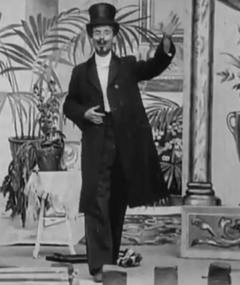
Also in 1897, there was another Méliès work that could fall under the umbrella of horror. The Bewitched Inn is about a man (played by Méliès himself) discovering a hotel room that has magical properties. Furniture disappears, a candle explodes when it is lit, and objects move of their own accord.
According to Wikipedia, this "is the first known Méliès film to feature inanimate objects coming to life to tease their owners, a theme that would return time and again throughout his work." Of course, Méliès' trademark splice trick shows up a few times to sell the idea of a magical room. This is all played more for laughs as opposed to trying to scare the audience.
The Bewitched Inn clocks in at under two minutes and was made by Méliès' Star Film Company.
In 1898, George Albert Smith pops up again as the director behind Photographing a Ghost. As the title suggests, it is about an attempt to take a picture of a ghost, which doesn't end up going so well.
Unfortunately, I can't find this anywhere online, and it appears to be lost. However, we do have a surviving description from the Edison Company. According to the summary, the short begins with two men carrying a case with the word "Ghost" written on it. A photographer opens it up and a "tall, white Thing" comes out. Eventually, the man tries to sit on the trunk to keep the ghost out, but when he turns around, he sees the ghost right behind him.
George Albert Smith
Also in 1898 is what appears to be the first American horror film, The Cavalier's Dream. It was directed by a very important figure in film history, Edwin S. Porter.
Porter is mostly known for making the 1903 film The Great Train Robbery, which is indisputably one of the most important works of the silent era. It influenced many followers largely because of its use of crosscutting, where events in two separate locations are happening simultaneously. The film cuts between them to show they are happening at the same time.
Like Photographing a Ghost, The Cavalier's Dream sadly seems to be lost and we only have an Edison Company description to go by. Said description indicates the short features Mephistopheles and an old witch who transforms into a beautiful young girl.
Edwin S. Porter
Moving on to 1899, there's another British horror film. This one is called The Miser's Doom and was directed by Walter R. Booth, who made some of the earliest science fiction films, such as 1909's The Airship Destroyer and the 1910 film The Aerial Submarine.
This film is also lost, but we do know it featured a ghost.
Walter R. Booth
Finally, we come to two more Méliès horror films, with these being released in 1899. The only surviving one of the two is The Devil in a Convent. It featured a devil (played by Méliès) causing chaos in a convent and was seen as a satire of Catholicism. A priest actually turns into the devil, so it makes sense that it was viewed as satirizing the church.
The other is Robbing Cleopatra's Tomb, which is lost. The plot centers on an attempt to resurrect Cleopatra's mummy. In 2005, it was claimed that a copy of this film was found, but it turned out to be another movie entirely.
Please follow me on Facebook or on Twitter @KinoPravdaBlog. I'm also on Instagram as lordofthewalri.
You can watch a video version of this article here.
The 1990s saw the beginning of video game adaptation to film and had a couple big hits such as Street Fighter and Mortal Kombat. However, in the next decade video game movies saw an increased mainstream acceptance with huge hits from equally big gaming franchises like Resident Evil and Tomb Raider. The early half of the 2000s doesn't feature the glut of game adaptations that we saw in later years, but it definitely set the course for what was to come.
The first one of the decade was in 2000, with Pokemon: The Movie 2000, an animated version of the incredibly popular RPG series published by Nintendo and developed by Game Freak. It was the second animated film based on Pokemon. In Japan, the film was released in 1999, but it came out in American theaters on July 21, 2000. Kunihiko Yuyama was the director and he was mainly known for his work in the Pokemon franchise.
The first live-action video game adaptation came in 2001, Lara Croft: Tomb Raider starring Angelina Jolie in the title role. Tomb Raider also featured her father, Jon Voight, and Iain Glen, who later played Jorah Mormont on Game of Thrones. Daniel Craig also appeared in one of his earlier roles.
At the time, Tomb Raider was the highest grossing action film with a female lead, unless you count Terminator 2: Judgement Day. The movie made $274 million worldwide on a budget of $115 million, easily making it a success.
Despite the film's financial success, the critical reception was much worse. On Rotten Tomatoes, its score is currently at a rather low 19 percent, and it was even nominated for a Razzie award for Worst Actress.
As far as video game adaptations go, it was one of the better ones. It was decently entertaining as a summer popcorn flick and that's all it ever intended to be.
Part 1 in this series covered the classic era of Star Fox (1993-2002) and can be read here. I also uploaded a video version of it.
Additionally, you can watch a Youtube version of the following article.
Many fans consider the classic era to be Star Fox's peak, but the years since then have been more of a mixed bag.
After Star Fox Adventures, Star Fox: Assault (the fourth game in the franchise), brought the series back to its space combat roots. It was released for the Nintendo Gamecube in 2005 (February of that year in North America and Japan).
The working title was "Star Fox Armada", but the subtitle was eventually changed to Assault. The game was developed by Nintendo and Namco, famed developers of Pac-Man, Tekken, Galaxian, and Ace Combat. Many of the same Namco developers who worked on Ace Combat 04: Shattered Skies helped make this game.
The directors for Assault were Toshiyuki Nakanishi, Hideki Okazaki, and Yutaka Yoshida. As far as producers go, they were Tsuyoshi Kobayashi, Shigeru Miyamoto, and Takaya Imamura, who was a graphic designer on Star Fox and the art director on Star Fox 64.
While the game was being developed a Star Fox arcade game was rumored, but nothing ever materialized from this.
After Adventure's shift in gameplay, Assault brought Star Fox back to being a space shooter. However, there were still on foot missions in addition to using the Arwing and Landmaster tank.
Assault was linear in terms of mission choices; the branching paths of earlier games such as Star Fox for the SNES and Star Fox 64 were gone.
Concerning the levels themselves, some were on rails and some allowed full freedom of movement. Furthermore, the player could even hop in and out of the Arwing at certain points.
You can also watch a video version of this article here.
While never as massive as Mario, Zelda, or Pokemon, Star Fox has been one of Nintendo's flagship series for over two decades. It all started in 1993 with a revolutionary game that brought 3D gaming to the masses.
The first game in the Star Fox series actually had its roots in a prototype called NESGlider, that was being developed for Nintendo's first home console, the Nintendo Entertainment System. The prototype was inspired by a game named Starglider, released in 1986 for the Atari ST, Commodore Amiga, MS-DOS, and Apple II, among other platforms. Starglider was developed by a British company named Argonaut Software. Argonaut was formed in 1982 and eventually worked on Star Fox with Nintendo EAD.
The prototype was then ported to Nintendo's next console, the SNES. However, the developers weren't satisfied with the 3D abilities of the Super Nintendo, so they decided to make special hardware in order to increase the SNES's 3D capabilities. This led to the creation of the very influential Super FX chip.
The Super FX was a coprocessor that allowed the SNES to render 3D polygons. The chip was included in the cartridge itself, which made games with the chip more expensive than other Super Nintendo games. Partly because of this fact, only a few games were made with the chip, including Dirt Racer, Dirt Track FX, and Vortex.
Star Fox was designed by Shigeru Miyamoto and Katsuya Eguchi. Miyamoto is one of the biggest names in gaming and had a hand in creating iconic Nintendo franchises such as Mario, The Legend of Zelda, F-Zero, and Pikmin. He created puppet characters for Star Fox that were eventually photographed for the cover.
Eguchi had previously worked as a designer on Super Mario Bros. 3 on the NES/Famicom, but this was the first title he directed. He would go on to direct Animal Crossing, Wave Race 64, and serve as a producer on Wii Sports, Nintendo Land, and Animal Crossing: New Leaf.
The characters were designed by Takaya Imamura, who would later be a producer on Star Fox Command for the Nintendo DS. Hajime Hirasawa composed the music.
The field of animation has been one of the most interesting and creative forms of film and its history goes almost all the way back to the beginning of movies.
The first example is a short two-minute film called The Enchanted Drawing from the year 1900. It was not entirely animated as it included live action footage, but it was the first movie with animated sequences as far as I am aware.
It consists of a man (in live-action) drawing a picture of a male face on an easel, as well as other objects such as a cigar and a glass of wine. He takes the drawings off the paper and they turn into real items. Also, the man in the drawing magically changes his facial expressions and this is where the stop-action animation part comes in. So it really isn't an animated film in the traditional sense, but it qualifies enough to be included here.
The Enchanted Drawing is a cute, gimmicky film that's definitely worth checking out to see the roots of animation.
The short was directed by a man named J. Stuart Blackton (he also starred in the film) who was born in the UK but came to the US at age 10. He is often referred to as the father of American animation.